
Stages
Stages split one form between different people. The first fills in their part and passes it on, then the next fills in theirs. It is one response, not several. Earlier answers stay visible to later people and cannot be changed, unless that stage may correct them.
Foldr Cloud now. Appliances from 11.3.
Turn it on
Section titled “Turn it on”On the Access tab of Settings, switch on Fill this form in stages. The form starts with two stages. Choose Add a stage for more.
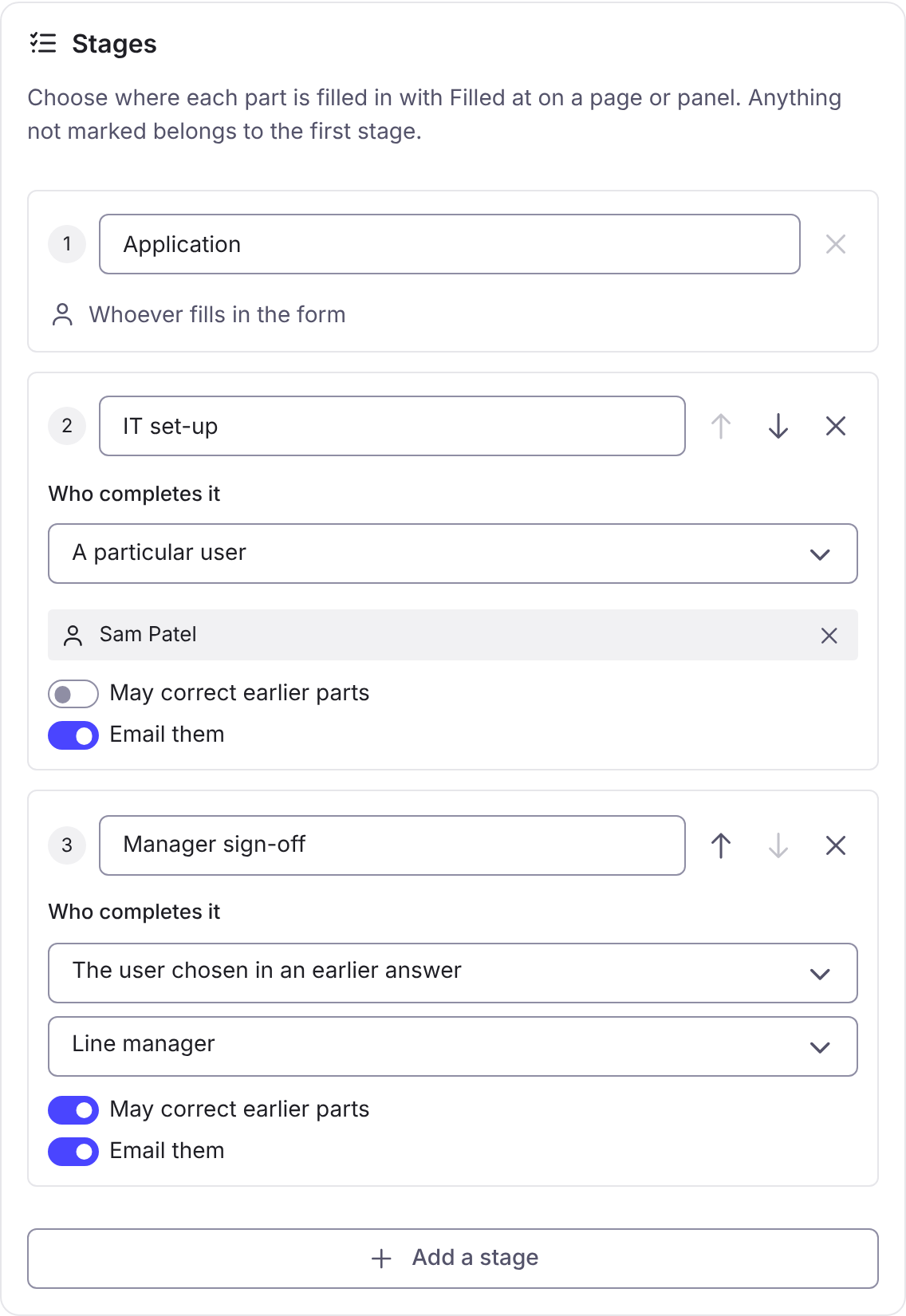
| Setting | Does |
|---|---|
| Stage name | What the stage is called. Every stage needs one. |
| Who completes it | Whoever fills in the form (the first stage only), A particular user, or The user chosen in an earlier answer, which names a Person question. |
| May correct earlier parts | The person at this stage can change what earlier stages entered. |
| Email them | Foldr emails the person when it is their turn. |
Then mark each part of the form. On a Page break or a Panel, Filled at says which stage fills that part. Same as the page keeps a panel with its page. Anything not marked belongs to the first stage.
- The first page always belongs to the first stage. Put later parts on a later page, or in a panel marked for that stage; publishing refuses a mark on the first page.
- In Build, each question’s card shows the name of the stage it is filled at.
- The person at a stage never sees parts filled at later stages.
- They see earlier parts and cannot change them, unless May correct earlier parts is on.
- The server enforces this. A request that tries to write another stage’s answer is refused with This answer cannot be changed. or This field is not accepted.
Publishing checks the stages. It refuses a stage with no name, a stage with nothing filled at it, a page filled at a stage that no longer exists, a missing person, and a person taken from a question that is not filled at an earlier stage.
Email them sends one email when it is their turn. Its subject reads “A response to form name is waiting for you”. While the response still waits on that person, Foldr sends reminders on the form’s own reminder schedule (Send reminders on the Access tab), up to three, and only when the stage has Email them on. A form that has closed, filled up or been archived still reminds the people its in-flight responses wait on.
Preview as stage in the builder has a stage switcher. It shows the form as a person at that stage would see it: their own part editable, earlier parts locked and later parts absent.
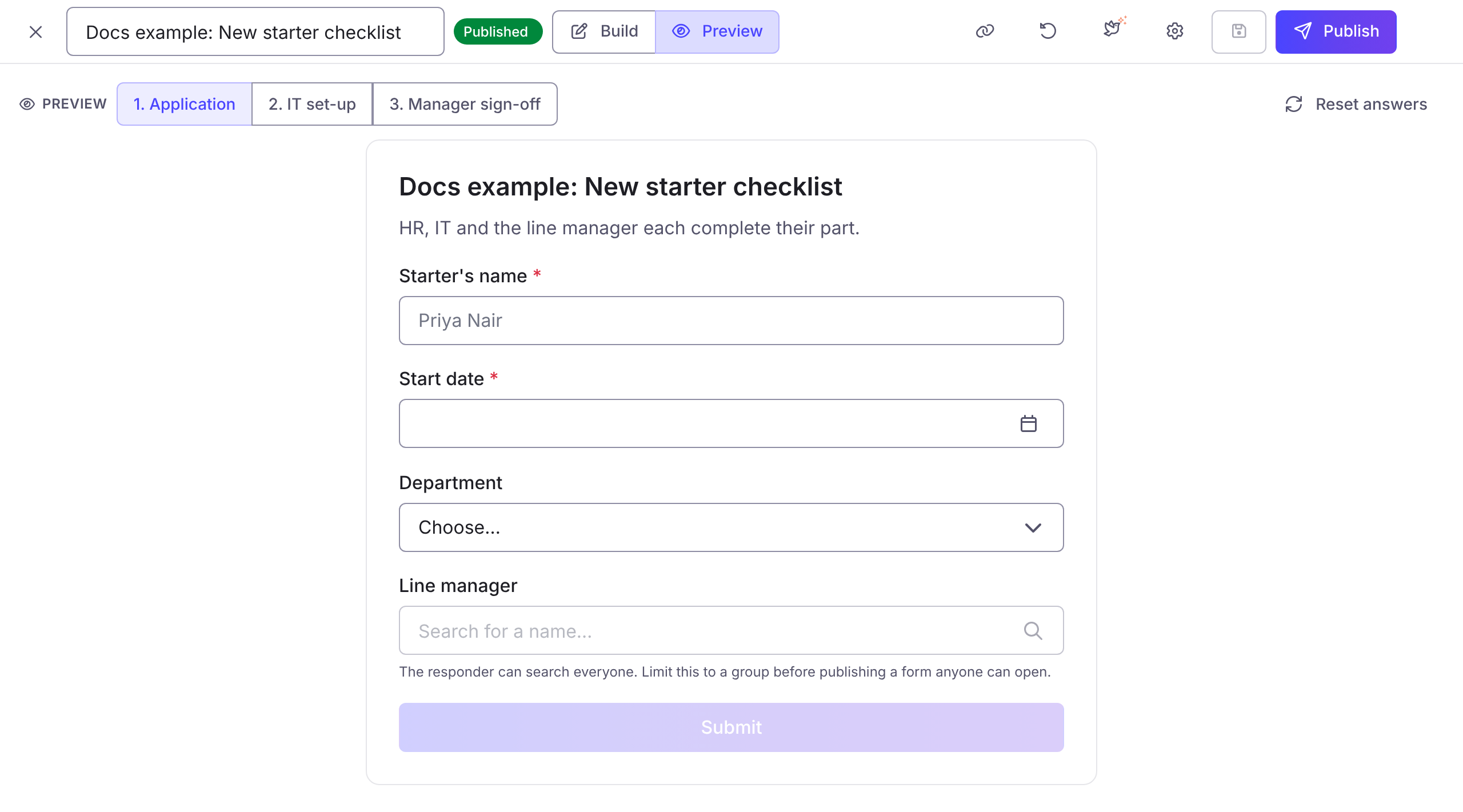
What the person sees
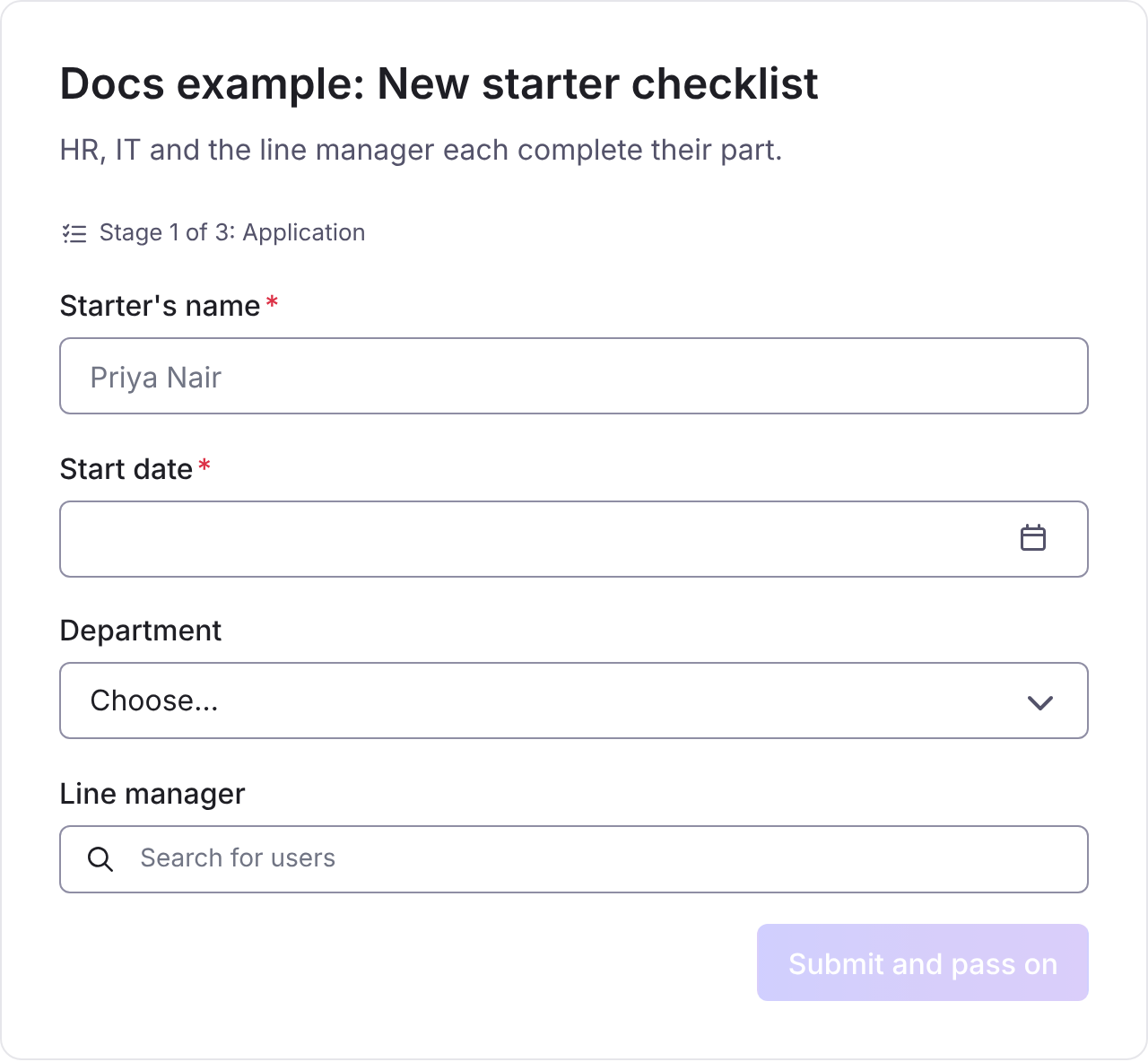
Section titled “What the person sees”The page shows Stage 1 of 3: Application, and the button reads Submit and pass on. After it, the person is told This has been passed on to the next person. The next person gets the form in Shared with me, and by email when Email them is on. They see Waiting for you and the stage name.
The first stage as the person filling it in sees it:
The next person opens the passed-on link and sees their stage, with the earlier answers shown and locked:
A person whose turn has passed, or who was replaced, sees This response is no longer waiting for you.
What the owner can do
Section titled “What the owner can do”On the Submissions page, responses show a status of Waiting at a stage, with Stage and Assigned to columns and a Filter by stage. Opening a response shows Stages completed.
- Reassign chooses another user for the current stage. They are emailed if the stage sends email. If a hand-off email failed, Reassign to the same user sends it again. The link still works and the response is in their Shared with me.
- Cancel response stops it waiting, and nothing more happens with it. This cannot be undone.
If the hand-off email could not be sent, the response stays open and its trail shows Hand-off email failed with who it was for and why. This covers an email that could not be built or queued, or that is switched off in Settings. It does not cover an email that was sent and later bounced.
Passing on, completing, reassigning and cancelling are all in the response’s activity trail.
When the last stage submits
Section titled “When the last stage submits”Only the last stage’s submit runs the form’s normal submit steps: the output file, custom fields, CSV, signing, approvals and automations. Earlier stages pass the response on and do nothing else. Send for signature to the submitter means the person at the first stage, and so does the receipt and the submitter email.
The owner’s PDF or Word record of a finished response has a Completed by section listing each stage, who completed it and when. The person who filled in the first stage does not see that section in their receipt.
Copying and importing
Section titled “Copying and importing”A form copied or imported from another tenant keeps its stages, but a named user does not travel between tenants. The stage asks for the user again (Pick the user again, with the old name shown) and publishing is refused until someone picks.
Person questions on a public form
Section titled “Person questions on a public form”A Person question filled at the first stage on a public form must still be limited to one or more groups. A Person question filled at a later stage needs no group limit: only the signed-in user the response was passed to can answer it, and they can search all users.
Not in this release
Section titled “Not in this release”Branches, a deadline for each stage and a group as the person for a stage are not built yet.